Texas Holdem strategy for beginners | 07 smart moves to try
Learn Texas Holdem strategy for beginners with 7 smart moves, from starting hands & position to pot odds & reading opponents, then practice for free to improve.
Your first Texas Holdem table can feel like everyone else got a rulebook you missed. The good news is that a solid Texas Holdem strategy for beginners doesn’t need complicated theory, just a few smart habits.
Texas Holdem strategy for beginners doesn’t need complicated theory
This guide covers seven of them, from choosing the right hands to managing your bankroll, and then shows you how to practice for free and track your progress.
07 key Texas Hold’em strategies for beginners
When learning Texas Holdem poker strategy, these seventips and tricks follow the order you’ll meet them at the table, from choices before the flop to habits that protect your chips. Try one or two in your next game, then add more as they start to feel natural.
07 key Texas Hold’em strategies for beginners
#1. Select starting hands based on their strength
Online, the next hand arrives in seconds, and it’s tempting to click ‘call’ just to stay involved. Choosing which two hole cards deserve your chips is the first decision you fully control. Here’s a simple way to sort them:
Select starting hands based on their strength
Premium: AA, KK, QQ, JJ, and AK; raise these almost every time. Pocket aces win about 85% of the time heads-up against a random hand.
Solid: 10-10, 9-9, AQ, and suited hands like KQ. Strong, but play them with care on scary boards.
Speculative: small pairs and suited connectors like 7♠6♠. They pay off when they hit, so play them cheaply.
Fold: weak offsuit hands like K-4 or J-3. They look tempting and quietly drain your balance.
Online tables deal far more hands per hour than live games, so a loose habit costs you faster. Every weak hand you fold keeps your stack ready for a better spot, which is why hand selection sits at the heart of any Texas Holdem strategy for beginners.
#2. Use table position to guide your decisions
Position is where you sit relative to the dealer button, and it decides when you act. Players who act later see what everyone else does first, so they decide with more information and less risk.
Use table position to guide your decisions
In early position, with many players still to act behind you, stick to premium and solid hands. As you move toward the cutoff and the button, the strongest seats, you can widen your range and act last after the flop. The blinds are the exception: you act first after the flop, so defending with weak hands there usually costs you more than it’s worth.
Online, the dealer button is clearly marked and moves every hand, so check your seat before you look at your cards. On 6-max tables, positions come around faster than in full-ring games, so a good hand in the wrong seat can turn tricky quickly.
#3. Calculate pot odds before making a call
Pot odds compare what it costs to call with what you can win. The formula is simple: divide the call amount by the total pot after you call. If the pot is 80 and your opponent bets 20, the pot becomes 100, and you must put in 20 to call. That’s 20 out of 120, so you need to win about 17% of the time for the call to pay off.
Calculate pot odds before making a call
Next, estimate your chances. Count your outs, the cards that complete your draw, and multiply by 4 on the flop or by 2 on the turn. A flush draw has 9 outs, giving you roughly 35% by the river, which makes that call an easy one.
Online, the pot size and call amount are shown on the screen, so do this quick math before you click. It’s a small habit that belongs in any ultimate Texas Holdem poker strategy: don’t let the decision timer rush you into calling on feel.
#4. Adjust bet sizes to match your objectives
Every bet should have a job: get paid by weaker hands, charge players who are chasing draws, or make a better hand fold. Once you know the goal, the size usually follows.
Adjust bet sizes to match your objectives
Before the flop, a standard open raise is about 2 to 3 big blinds. After the flop, bets between half pot and three-quarters pot cover most situations. Go bigger on wet boards, where flush and straight draws are common, because you want to make those draws pay. Go smaller on dry boards, where fewer hands can catch up.
Online, most poker clients have quick-bet buttons for half pot, three-quarters pot, and full pot, so there’s no need to type amounts. Stick to a few consistent sizes, since random amounts can give away the strength of your hand to anyone paying attention.
#5. Smart aggression: when to push and when to pause
Aggressive poker doesn’t mean betting every hand. It means betting and raising with a reason. A bet can win in two ways: either opponents fold, or you hold the best hand at showdown, while passive calling only wins at showdown.
Smart aggression: when to push and when to pause
Push when you have a strong hand and want worse hands to pay, which is value betting, or when you have a good draw. A flush draw can bluff and still hit about 35% of the time by the river. A pure bluff works best against players who can fold. A half-pot bluff needs to succeed only about one time in three to break even.
Pause with medium hands like second pair, where checking or betting small keeps the pot manageable. Fold when a tight player bets big on the turn or river and your hand isn’t strong enough for the price. Online, you face many strangers with no history, so don’t bluff against opponents who rarely fold.
#6. Read opponents through their betting patterns
Online, you can’t see faces or body language, so betting patterns are your main source of information. Watch how often a player raises, calls, or folds, and sort them into simple types. Tight players play few hands, loose players play many, passive players mostly call, and aggressive players bet and raise often.
Read opponents through their betting patterns
A tight player who suddenly raises big deserves respect, while a loose player who keeps calling probably has a weaker hand than you’d expect. Bet sizing and timing add more clues. A sudden change in size can signal strength or a bluff, and an instant call often points to a simple draw or a marginal hand.
Treat timing as a hint only, since many players use other tabs or step away. Most sites let you save notes on players, which helps if you meet the same opponents again. Rules on tracking software differ between sites, so check your site’s policy first.
#7. Budget like a pro – survive the ups & downs of poker
Even the best hands lose sometimes. Pocket aces still lose about 15% of the time heads-up, and short-term swings, known as variance, hit skilled players too. A bankroll is money set aside only for poker, separate from rent, bills, and savings, so a bad run doesn’t end your game.
Budget like a pro – survive the ups & downs of poker
A common guideline for cash games is to hold at least 20 buy-ins for your stakes. Move up only when your bankroll comfortably covers it, and set a loss limit for each session instead of chasing losses.
Online, deposits take seconds, which makes overspending easy. Use the deposit limits and session reminders most sites offer, because managing your money is part of any Texas Holdem poker basic strategy. Play only with money you can afford to lose.
How to build and test your Texas Hold ’em Poker skills
Learning how to play Texas Hold’em poker for beginners doesn’t stop at the strategies, because skill comes from using them. These three habits help you practice safely online, learn from real hands, and see whether you’re actually improving.
How to build and test your Texas Hold ’em Poker skills
#1. Start with free-play poker games
Free-play tables use virtual chips, often called play money, so you can learn the buttons, the pace, and the flow of a hand without risking your balance. They’re a good place to practice one skill at a time, such as position or pot odds. Real-money games are different: every chip is your own money, and the stakes change how people play. Play-money opponents also tend to call far too often, so don’t expect their mistakes to carry over.
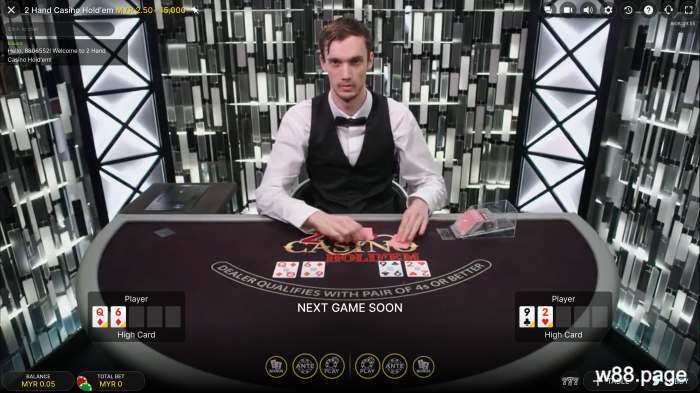
Start with free-play poker games at W88 online casino
Free play isn’t offered on every platform or in every region, so check what’s available where you live before you sign up. If you are looking for a place to start, you can see whether a free-play or demo mode is open to you on W88 online casino, and read the terms on any real-money tables before you deposit.
#2. Study example hands and possible outcomes
Walking through sample hands is one of the fastest ways to build instincts. Take a hand and follow it street by street, from preflop to the river, asking what your opponent could hold at each point and what you would do.
Study example hands and possible outcomes
Then compare the result with the odds, because a good decision can still lose and a bad one can still win. Strategy articles, hand-equity calculators, and your own saved hands all make good study material.
#3. Review your decisions to identify areas for improvement
After each session, note the hands that felt close, such as big pots, tough calls, and anything you weren’t sure about. Judge each one by the information you had at the time, not by whether you won.
Review your decisions to identify areas for improvement
Over several sessions, repeated mistakes start to show, like calling too often or playing weak hands from early position. Work on one habit at a time, and track your results across many sessions, since a single night says little.
Conclusion
A strong Texas Holdem strategy for beginners comes down to a few repeatable habits: choose your hands carefully, use your position, check the pot odds, size your bets with a purpose, and know when to push or pause. Add a close eye on opponents and a protected bankroll, and your online decision-making will get steadier.
Start with one or two of these moves, practice for free, and review your hands. Play responsibly, and only with money you can afford to lose.