07 Keno winning formulas using the maths of odds and payouts
Keno winning formula explained through 07 core strategies, from pick size and paytable returns to hot & cold numbers and the Martingale, checked against the odds.
Many players search for a Keno winning formula, hoping to find a pattern or system that tips the game in their favour. Keno looks simple: 20 numbers are drawn from 80, and your payout depends on how many of your picks match.
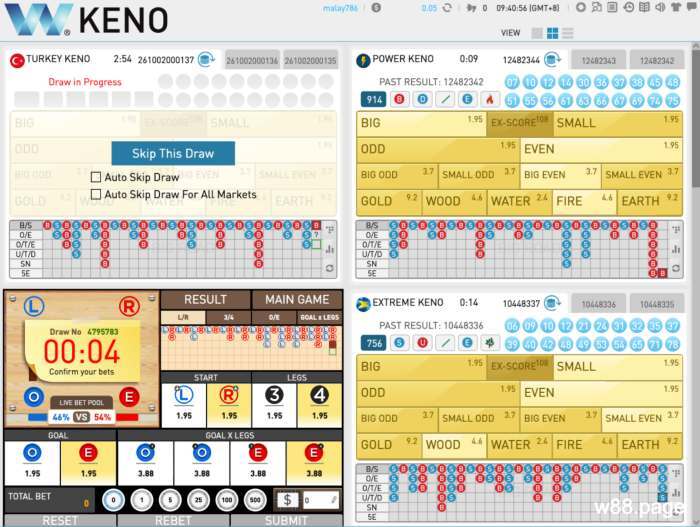
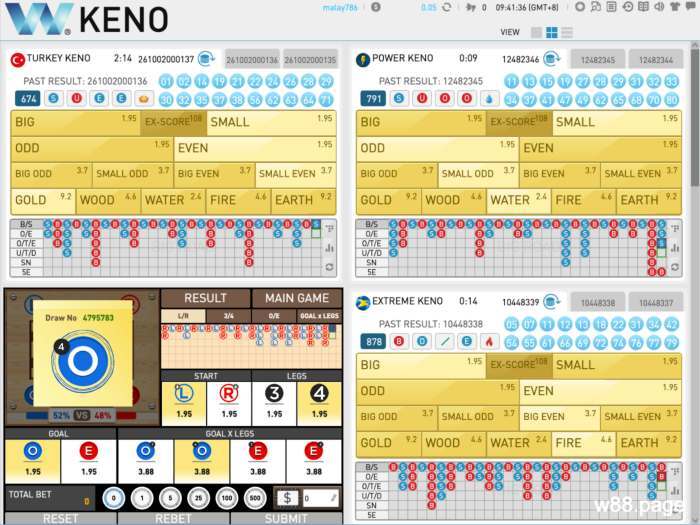
W Keno online gameplay at W88 online
But every draw is independent, and the game is built to pay back less than it takes in. No formula changes that. The maths can show what each bet is really worth, and this guide tests seven popular strategies against it.
What is the Keno Formula, and how does it differ from other methods?
A Keno Formula is a calculation that tells you what a bet is worth. The core one gives the chance of matching a set number of your picks: C(n,k) × C(80−n, 20−k) ÷ C(80,20), where n is how many numbers you pick and k is how many you match. From there, you can work out your expected return and the house edge.
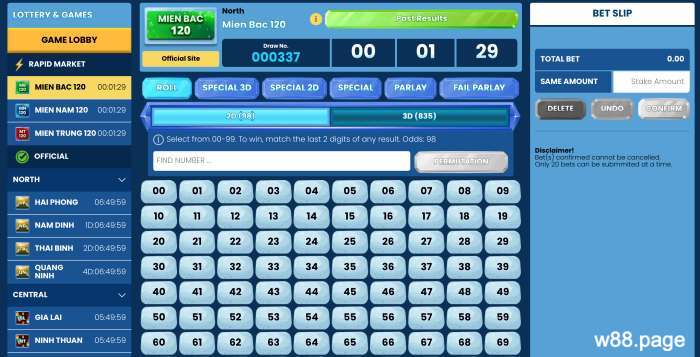
Keno online gameplay at W88 Malaysia
Take a 1-spot ticket; twenty of the 80 numbers are drawn, so you hit 25% of the time. If a hit pays 3 for 1, you get back 75% on average, which leaves the house a 25% edge.
Other methods, such as lucky numbers, hot and cold picks, patterns, pr betting systems, are rules for choosing numbers or sizing bets. A formula measures a bet, while these methods try to change the result and probability.
Top 07 Keno winning formulas and strategies pro players use
These are seven tips and tricks Keno players commonly use, from choosing how many spots to pick to doubling the bet after a loss. Each one is tested against the maths, so you can see what it changes and what it doesn’t.
#1. The pick-size strategy
Pick size is how many numbers you mark on a Keno ticket, usually from 1 to 10. It changes two things: how hard it is to hit all your numbers, and how many numbers you can expect to match on an average draw.
Example: compare a 3-spot ticket with a 10-spot ticket. On 3 spots, you hit all three about once in every 72 tickets and match 0.75 numbers per draw on average. On 10 spots, hitting all ten is a 1 in 8,911,711 shot, but you match 2.5 numbers on average and land at least one match about 95% of the time.
Large numbers are picked in the Keno online
The formulas are simple. The chance of hitting every spot is C(20,n) ÷ C(80,n), and the average number of matches is n × 20 ÷ 80, where n is your pick size.
So fewer spots make a full hit far more likely but cap the prize, while more spots give you frequent partial matches and a jackpot that rarely lands. Pick size changes how your wins are spread out, not the house edge. Many paytables only pay from a minimum number of matches, so “at least one match” does not always mean a win, and the paytable shows what each match count pays.
#2. Auto-pick vs manual picks
Auto-pick lets the game choose your numbers at random, while manual picks let you choose them yourself. Neither gives you better odds, because every number has the same 25% chance of being drawn (20 out of 80) in every game, and past draws don’t affect the next one.
Example: take two 5-spot tickets. One is a manual pick of 1, 2, 3, 4, 5, and the other is an auto-pick that happens to give 7, 23, 41, 58, 76. Many players feel that 1-2-3-4-5 is less likely to come up because it looks like a pattern, but it isn’t. Both tickets have the same chance of hitting all five: C(20,5) ÷ C(80,5) = 15,504 ÷ 24,040,016, or about 1 in 1,551. Both also average 1.25 matches per draw.
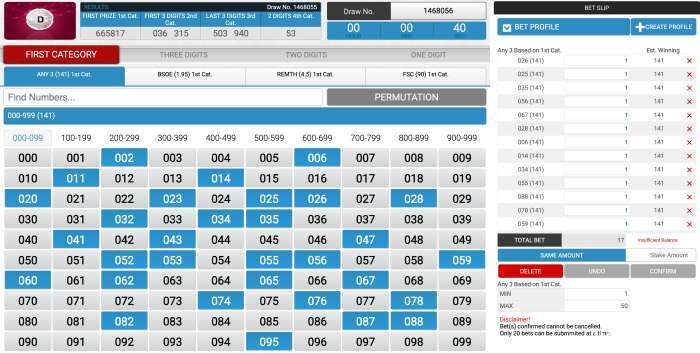
Manually picked numbers in Keno online at W88 official website
So the choice comes down to convenience and feel. Manual picks suit players who like using favourite numbers, while auto-pick is faster and removes personal bias. The paytable and house edge are the same either way.
#3. Hot and cold numbers
Hot and cold number strategies use past Keno results to pick numbers. Hot numbers are those drawn often in recent games, and cold numbers are those drawn rarely. Some players pick the hot ones because they seem to be on a streak, while others pick the cold ones because they seem overdue.
Neither idea works, because every draw is independent. Each of the 80 numbers has a 20 in 80 (25%) chance of being drawn in every game, no matter what happened before.
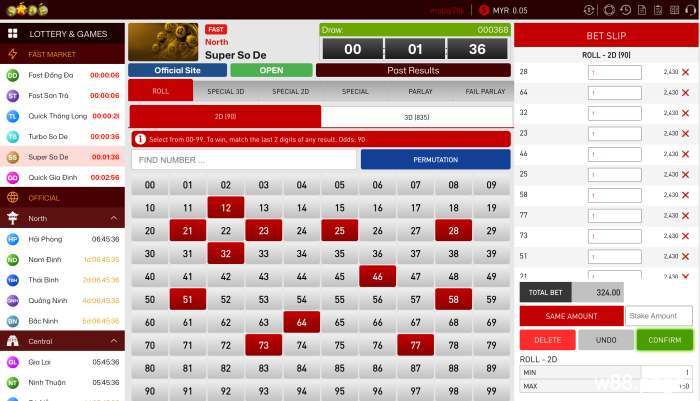
Keno online gameplay at W88 Lotto/Keno lobby
Example: suppose number 17 was drawn in 6 of the last 10 games and number 52 was drawn in none. On average, any number appears 2.5 times in 10 draws, so 17 looks hot and 52 looks cold. For the next draw, though, both still have exactly a 25% chance. Streaks like this also happen by chance. In any 10-draw window, you’d expect about 1.6 numbers to appear six or more times and about 4.5 numbers to miss every draw, so some numbers will always look hot or cold.
#4. Pattern and spread betting
Pattern and spread betting means choosing your numbers by where they sit on the Keno board instead of picking them freely. Players may spread their picks evenly, stick to one row or column, or trace a shape such as a diagonal or a corner cluster.
None of this changes the odds. Every number has the same 25% chance of being drawn, so any set of numbers has the same probability as any other set of the same size, wherever it sits on the board.
Spread betting shown in Keno online at W88 official
Example: take two 5-spot tickets on the 80-number board. One is clustered in the top-left corner (1, 2, 3, 11, 12), and the other is spread out (4, 27, 39, 62, 78). Both have the same chance of hitting all five, 1 in 1,551, and both average 1.25 matches per draw.
Some games also let you bet on a region of the board, such as the top, bottom, left, right, or edge. These are separate bets with their own paytables, and returns range from about 72% to 94% depending on the paytable. So the paytable matters more than the pattern.
#5. Comparing paytables by return
How does Keno work when it comes to payouts? The paytable lists what a game pays for each number of matches. To compare paytables, work out the expected return: multiply each payout by its chance of hitting, then add the results.
Example: a 1-spot ticket hits 25% of the time, so a 3 for 1 payout returns 25% × 3 = 75%. A 2-spot ticket needs both numbers, which happens about 6% of the time, so a 12-for-1 payout returns 6.01% × 12 = 72.2%. The bigger payout hits far less often, so the return is about the same. If another game paid 14 for 1 on the same bet, the return would rise to 84.2%, or about RM84 back per RM100 wagered instead of RM72.
Ongoing Keno online gameplay at W88
So choose the paytable with the highest return, not the biggest headline payout. Wizard of Odds shows Power Keno paytables ranging from about 86% to 94%, and every one stays below 100%.
#6. Lucky number selection
Lucky number selection means choosing numbers for personal reasons, such as birthdays, anniversaries, or a favourite number. It can make a ticket feel more meaningful, but it does not change how the draw works.
Every number has the same 20 in 80 (25%) chance of being drawn in each game. A number picked because it feels lucky, like 7, is no more likely to appear than 23 or 58.
Ongoing W Keno online gameplay at W88
Example: a birthday ticket with 3, 14, 21, 27 and 30 and a ticket with 38, 45, 52, 66 and 79 both have a 1 in 1,551 chance of hitting all five, and both average 1.25 matches per draw. Birthdays only cover 1 to 31, so a birthday ticket uses a smaller part of the board, but that doesn’t change its odds. Lucky numbers can be part of your style, but they are not a formula for improving your odds.
#7. The Martingale and other betting systems
The Martingale is a staking system where you raise your bet after each loss, usually by doubling it, so one win can recover earlier losses. Other systems use different sequences, but all of them change how much you bet, not the chance of your numbers being drawn.
Keno online gameplay at W88 website
Example: on a 1-spot ticket, you hit 25% of the time, so you miss 75% of the time. Start at RM5 and double after every miss. After 6 misses in a row, which happens about 18% of the time, your next bet is RM320, and you have already lost RM315. After 8 misses in a row, about 10% of the time, the next bet is RM1,280, and you are RM1,275 down. The bets double with each loss, but the odds stay the same.
Where to play Keno in Malaysia: choose a safe & licensed platform
If you want to play Keno online in Malaysia, W88 login offers multiple keno and lotto games by Gameplay Interactive. The game uses the standard keno format, where you select numbers and win when your picks match the numbers drawn.
Keno at W88 lobby
On W88 Malaysia, keno bets start from RM2 and go up to RM20,000 per bet. To access the game, log in to your W88 account and open Keno by Gameplay Interactive. Your potential payout depends on your pick size and the number of matching numbers, with the paytable showing the return for each winning combination.
Keno online at W88 official website
Before placing a bet, review the available Keno paytable and choose a stake that fits your budget. Remember that every draw is independent, so no number-selection strategy can guarantee a win or change the underlying odds.
Conclusion
There is no guaranteed Keno winning formula, but understanding the maths behind the game can help you make more informed betting choices. Pick size, number-selection methods, paytables, and staking systems all affect how you approach a bet, but they do not change the underlying odds of each draw.